On this page:
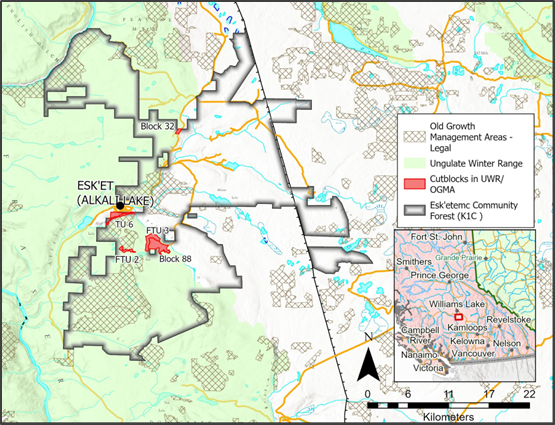
Investigation area near Alkali Lake, showing cutblocks, ungulate winter range, and old growth management areas.
In 2024, the Board received a complaint from the Stswecem’c Xget’tem First Nation regarding harvesting carried out by Esk’etemc within mule deer winter range and old growth management areas near Alkali Lake in the Cariboo-Chilcotin Natural Resource District.
As part of its investigation, the Board examined whether harvesting complied with legal requirements under the Forest and Range Practices Act and related regulations, including requirements for mule deer winter range and old growth management areas. This summary outlines the main findings and their significance for forest practices in BC.
The investigation focused on whether harvesting, carried out as part of wildfire risk reduction treatments, complied with applicable requirements. Specifically, the Board examined whether the licensee:
Licensee: Esk’etemc (Community Forest Agreement K1C)
Complainant: Stswecem’c Xget’tem First Nation
Government: Ministry of Forests – Natural Resource Officer Service (formerly the Compliance and Enforcement Branch)
Wildfire risk reduction is a growing priority in complex landscapes
Many First Nation and non-Indigenous communities face threats from wildfire in British Columbia. After two years of high wildfire risks, including evacuation uncertainty during the 2017 and 2018 fire seasons, Esk’etemc (the licensee) prioritized wildfire risk reduction harvesting on the landscapes surrounding their community near Alkali Lake.
In implementing wildfire risk reduction harvesting, the licensee found itself in conflict with the competing priority of habitat requirements for mule deer winter range. This is not an uncommon situation since wildfire risk reduction has become an elevated priority for First Nations, local governments, and the provincial government.
A procedural error, but outcomes supported safety and habitat
In this case, the licensee made an administrative error when planning one of its cutblocks as it did not follow the legal process for requesting an exemption from following the general wildlife measures in the Government Actions Regulation (GAR) order for ungulate winter range on one cutblock. The outcome on the ground was beneficial for wildfire risk reduction and wildlife habitat, and was consistent with old growth management requirements.
At this time, there are no legal objectives to guide wildfire risk reduction activities. These activities are often implemented in areas where objectives for other values establish legal—and sometimes conflicting—requirements for results on the ground. With an appropriate prescription, wildfire risk reduction treatments can also benefit mule deer winter range.
More adaptive and integrated approaches are needed
The Board identified the limitations of GAR orders in its special investigation Management of Habitat for Species at Risk under the Forest and Range Practices Act, noting that static reserves may not be resilient nor adaptive to natural disturbance.
The Board sees opportunity for an integrated and adaptive approach to address current and emerging wildlife needs as well as resilience to natural and climate change-induced disturbances, including wildfire.
_______________
The Forest Practices Board recognizes that the work examined in this report took place within the territories of Secwépemc communities, including Esk’etemc, Stswecem’c Xget’tem First Nation, Williams Lake First Nation, Whispering Pines/Clinton Indian Band, and Neskonlith Indian Band.
The Board acknowledges their deep connection to and longstanding stewardship of these lands.
_______________
Media & Contact
For interview requests or additional information, contact:
Tanner Senko, Communications Manager
Email: tanner.senko@bcfpb.ca
Phone: 250-889-8211